Collagen peptides and whey can both appear in the protein aisle, but equal protein numbers do not settle which product fits your purpose. Start by comparing the serving weight, the grams of protein and the ingredient list. Then ask what evidence supports the particular result you want. Those are separate questions, and keeping them separate makes a crowded label much easier to read.
This worksheet is for comparing dietary protein powders. It does not recommend a personal intake or a treatment. The two labels below are invented examples, so the numbers illustrate the method without making claims about an actual brand.
Write down the question before comparing the tubs
“Which is better?” is too broad to be useful. You might be trying to compare prices, understand a scoop size, choose a convenient food ingredient or assess a muscle-related claim. Write that purpose at the top of your notes. A comparison that answers one question may leave the others open.
The NIH Office of Dietary Supplements explains that both protein quantity and quality matter. Whey is a milk-derived protein that supplies all nine essential amino acids. NIH also places supplements within the wider diet: a powder can help fill a dietary need, but it does not replace adequate food, energy and hydration. That background is more useful than treating the largest number on a package as an automatic winner.
Step 1: Put both servings on the same basis
| Label detail | Hypothetical collagen powder A | Hypothetical whey powder B |
|---|---|---|
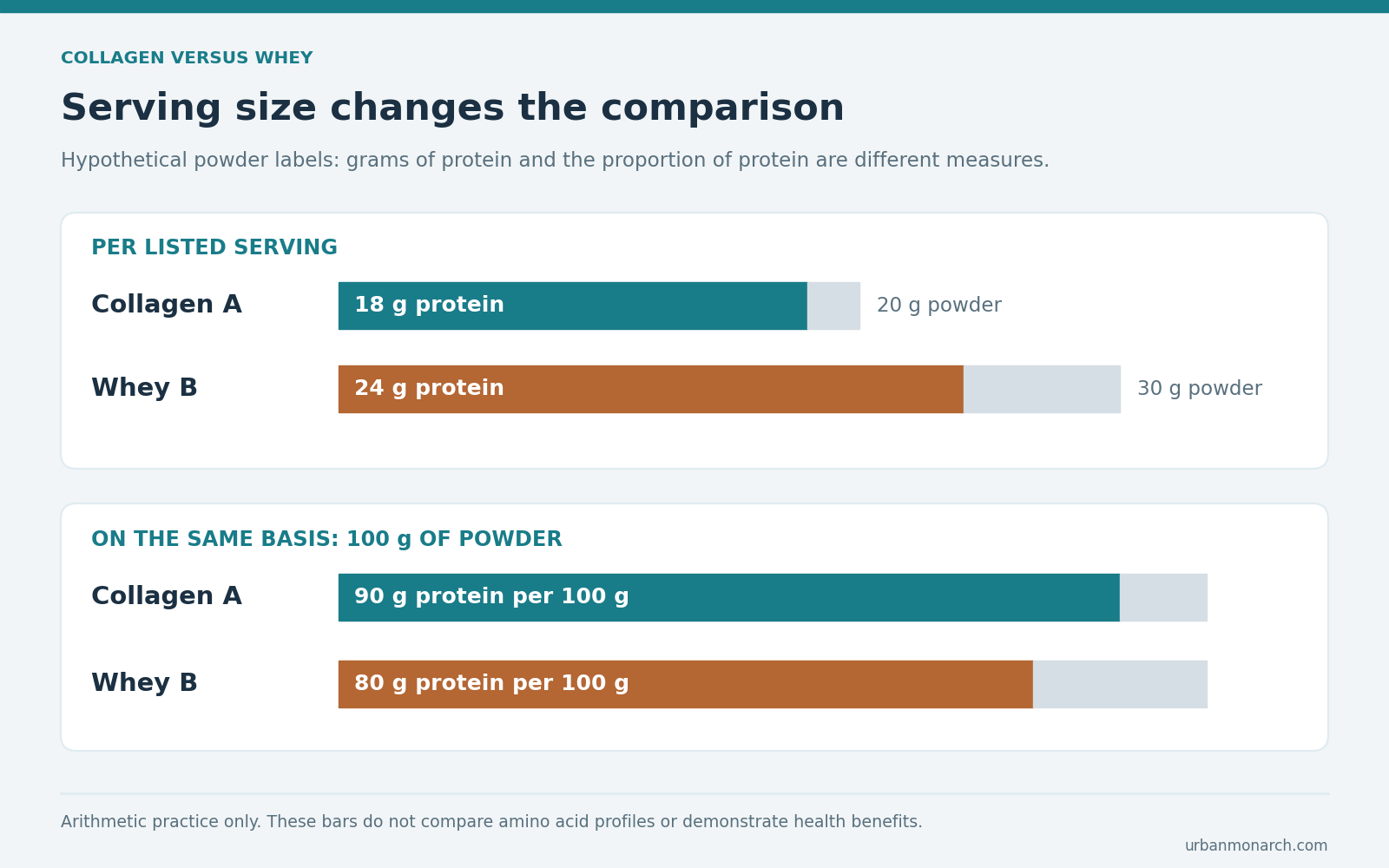
| Serving weight | 20 g of powder | 30 g of powder |
| Protein per serving | 18 g | 24 g |
| Protein per 100 g of powder | 90 g | 80 g |
| Servings in the tub | 25 | 20 |
| Example price | $25 | $24 |
| Cost per listed serving | $1.00 | $1.20 |
Powder B has more protein per serving because its serving is larger. Powder A has a higher proportion of protein by weight. Both statements can be true. Neither calculation tells you which amino acids the protein supplies or whether either product has demonstrated a particular health benefit.
To calculate protein per 100 grams, divide protein grams by serving grams and multiply by 100. For A, that is 18 ÷ 20 × 100 = 90. For B, it is 24 ÷ 30 × 100 = 80. Use the printed gram weights rather than assuming two different scoops hold the same amount.
Step 2: Check what the price comparison actually measures
The example tub of A contains 25 × 18 = 450 grams of listed protein. B contains 20 × 24 = 480 grams. Dividing the price by those totals gives approximately 5.6 cents per gram for A and 5.0 cents for B.
That is a shopping calculation, not a measure of muscle growth or overall value. It also changes if a discount, delivery charge or different pack size changes the price. Keep your arithmetic visible so you can update it rather than relying on a “best value” badge.
If you would use a different amount from the label’s serving, calculate its cost separately. Do not silently switch between cost per scoop, per serving and per tub while comparing products.
Step 3: Read the ingredient identity
Copy the named protein source into your worksheet. If a product combines several sources, record the blend as a blend. Do not assign all its protein to the ingredient featured most prominently on the front.
Next, list practical requirements: ingredients you need to avoid, preferred flavour, whether you want an unflavoured powder and whether the pack gives enough information to identify its source. Check the actual label for allergen information. A product cannot be a useful choice for you merely because its arithmetic looks attractive.
Keep “unknown” as a legitimate answer. If the relative amounts in a blend are not supplied, you cannot calculate them from the order of words in an advertising headline.
Step 4: Keep research conclusions specific
A randomized trial published in 2024 compared whey, pea and collagen protein in 31 older men. Under the study’s controlled conditions, the whey and pea groups showed increased integrated muscle protein synthesis compared with their controlled-diet phase; the collagen group did not show that increase.
This was a short study of a biological measurement in a particular population. It did not establish which powder every younger gym-goer should choose, measure a lifetime training result or test every proposed use of collagen. It illustrates why equal protein grams cannot, by themselves, prove equivalent effects.
When a product cites research, make a three-line note: who was studied, what was measured and what was actually consumed. If the headline changes any of those details, return to the paper before accepting the claim. A result about one formulation or outcome does not automatically answer a different question.
Does the comparison change on a rest day?
A rest day does not change either label’s ingredient list or the arithmetic above. It changes the context in which you are asking the question. Instead of automatically switching powders because you are not training that day, first identify what you want the product to add to your meals.
Neither the example labels nor the cited trial provides a personal rest-day prescription. If a medical condition or a prescribed eating plan affects your protein choices, use that plan and ask the clinician or dietitian responsible for it.
Keep dietary peptides and experimental products separate
This comparison concerns collagen peptides as a dietary protein ingredient. It does not assess experimental injectable peptides. Sharing the word “peptide” does not make products interchangeable, and research on a dietary powder cannot establish the safety or effectiveness of an unrelated injectable substance.
Save the version you compared
Photograph the complete label or save the product information you actually used. Include the pack size and the date you checked the price. If a retailer later changes its listing, you can see which calculation needs updating. Keep an empty field for details you could not confirm rather than borrowing a number from a similar product. Your worksheet should describe one identifiable comparison, with its assumptions visible.
Finish your worksheet with four entries: the protein source, the amount on a consistent basis, the cost on that same basis and the specific claim you still need evidence for. You will then know what the label answers, what your calculations answer and what remains uncertain before making a decision.