
Urban Monarch: Evolving the Modern Man
Welcome to Urban Monarch, the ultimate machine of evolution for the modern man. From its inception, Urban Monarch has been a relentless experiment dedicated to helping men become better versions of themselves. Join us on this perpetual journey of growth, knowledge, and self-improvement.
The 5 Traits that Define Urban Monarch
Urban Monarch stands on five key pillars that shape our mission and content:
- Masculine: Embracing the essence of manhood with strength, confidence, and integrity.
- Evolved: Continuously adapting and growing to meet the challenges of the modern world.
- Liberated: Breaking free from outdated stereotypes and embracing a broader perspective of masculinity.
- Ubiquitous: Ensuring our content is accessible and relevant to men everywhere.
- Savvy: Equipping men with the knowledge and skills to navigate life’s complexities with wisdom and finesse.
The Schedule
To keep you engaged and informed, Urban Monarch releases new content three times a day, five days a week. Our schedule ensures you get a constant stream of fresh insights and perspectives. Check for new posts at:
- 9:00 AM MST
- 12:00 PM MST
- 4:00 PM MST
Stay tuned every weekday for our latest articles and snippets designed to enhance your journey.
Subscription Services
Stay connected with Urban Monarch through our convenient subscription services:
- Daily Emails: Receive the latest articles and updates directly in your inbox every day.
- RSS Feed: Subscribe to our RSS feed for instant access to new content.
Visit our subscribe page for more information and to sign up.
Join the Urban Monarch community and embark on a path of continuous evolution. Together, we can redefine what it means to be a modern man.
-
Collagen Peptides vs Whey: A Label Comparison Worksheet
Collagen peptides and whey can both appear in the protein aisle, but equal protein numbers do not settle which product fits your purpose. Start by comparing the serving weight, the grams of protein and the ingredient list. Then ask what evidence supports the particular result you want. Those are separate questions, and keeping them separate makes a crowded label much easier to read.
This worksheet is for comparing dietary protein powders. It does not recommend a personal intake or a treatment. The two labels below are invented examples, so the numbers illustrate the method without making claims about an actual brand.
Write down the question before comparing the tubs
“Which is better?” is too broad to be useful. You might be trying to compare prices, understand a scoop size, choose a convenient food ingredient or assess a muscle-related claim. Write that purpose at the top of your notes. A comparison that answers one question may leave the others open.
The NIH Office of Dietary Supplements explains that both protein quantity and quality matter. Whey is a milk-derived protein that supplies all nine essential amino acids. NIH also places supplements within the wider diet: a powder can help fill a dietary need, but it does not replace adequate food, energy and hydration. That background is more useful than treating the largest number on a package as an automatic winner.
Step 1: Put both servings on the same basis
Hypothetical labels for arithmetic practice Label detail Hypothetical collagen powder A Hypothetical whey powder B Serving weight 20 g of powder 30 g of powder Protein per serving 18 g 24 g Protein per 100 g of powder 90 g 80 g Servings in the tub 25 20 Example price $25 $24 Cost per listed serving $1.00 $1.20 Powder B has more protein per serving because its serving is larger. Powder A has a higher proportion of protein by weight. Both statements can be true. Neither calculation tells you which amino acids the protein supplies or whether either product has demonstrated a particular health benefit.
To calculate protein per 100 grams, divide protein grams by serving grams and multiply by 100. For A, that is 18 ÷ 20 × 100 = 90. For B, it is 24 ÷ 30 × 100 = 80. Use the printed gram weights rather than assuming two different scoops hold the same amount.
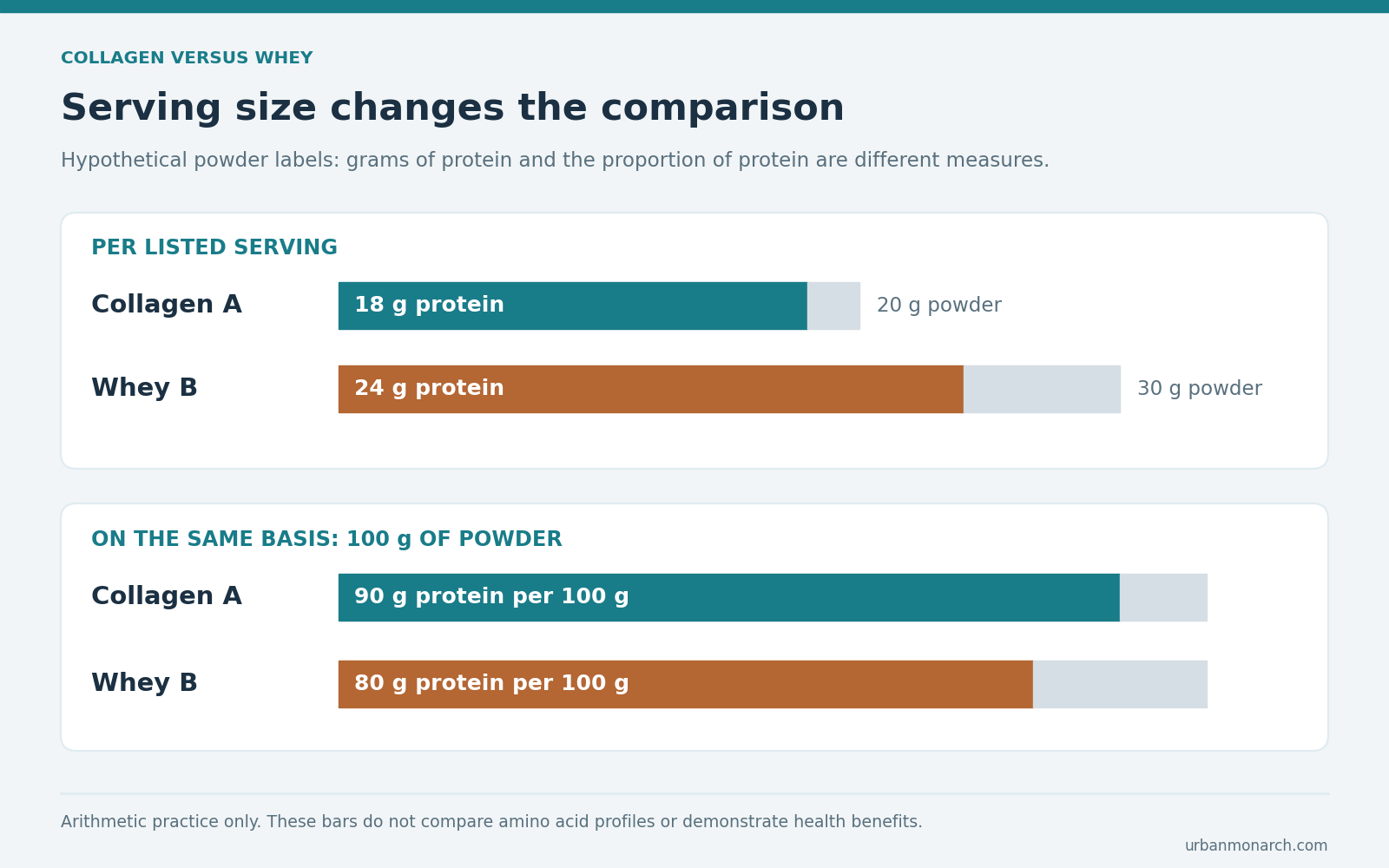
Invented labels show why protein per serving and protein proportion can rank differently. The graphic does not compare amino-acid profiles or health benefits. Image credits. Step 2: Check what the price comparison actually measures
The example tub of A contains 25 × 18 = 450 grams of listed protein. B contains 20 × 24 = 480 grams. Dividing the price by those totals gives approximately 5.6 cents per gram for A and 5.0 cents for B.
That is a shopping calculation, not a measure of muscle growth or overall value. It also changes if a discount, delivery charge or different pack size changes the price. Keep your arithmetic visible so you can update it rather than relying on a “best value” badge.
If you would use a different amount from the label’s serving, calculate its cost separately. Do not silently switch between cost per scoop, per serving and per tub while comparing products.
Step 3: Read the ingredient identity
Copy the named protein source into your worksheet. If a product combines several sources, record the blend as a blend. Do not assign all its protein to the ingredient featured most prominently on the front.
Next, list practical requirements: ingredients you need to avoid, preferred flavour, whether you want an unflavoured powder and whether the pack gives enough information to identify its source. Check the actual label for allergen information. A product cannot be a useful choice for you merely because its arithmetic looks attractive.
Keep “unknown” as a legitimate answer. If the relative amounts in a blend are not supplied, you cannot calculate them from the order of words in an advertising headline.
Step 4: Keep research conclusions specific
A randomized trial published in 2024 compared whey, pea and collagen protein in 31 older men. Under the study’s controlled conditions, the whey and pea groups showed increased integrated muscle protein synthesis compared with their controlled-diet phase; the collagen group did not show that increase.
This was a short study of a biological measurement in a particular population. It did not establish which powder every younger gym-goer should choose, measure a lifetime training result or test every proposed use of collagen. It illustrates why equal protein grams cannot, by themselves, prove equivalent effects.
When a product cites research, make a three-line note: who was studied, what was measured and what was actually consumed. If the headline changes any of those details, return to the paper before accepting the claim. A result about one formulation or outcome does not automatically answer a different question.
Does the comparison change on a rest day?
A rest day does not change either label’s ingredient list or the arithmetic above. It changes the context in which you are asking the question. Instead of automatically switching powders because you are not training that day, first identify what you want the product to add to your meals.
Neither the example labels nor the cited trial provides a personal rest-day prescription. If a medical condition or a prescribed eating plan affects your protein choices, use that plan and ask the clinician or dietitian responsible for it.
Keep dietary peptides and experimental products separate
This comparison concerns collagen peptides as a dietary protein ingredient. It does not assess experimental injectable peptides. Sharing the word “peptide” does not make products interchangeable, and research on a dietary powder cannot establish the safety or effectiveness of an unrelated injectable substance.
Save the version you compared
Photograph the complete label or save the product information you actually used. Include the pack size and the date you checked the price. If a retailer later changes its listing, you can see which calculation needs updating. Keep an empty field for details you could not confirm rather than borrowing a number from a similar product. Your worksheet should describe one identifiable comparison, with its assumptions visible.
Finish your worksheet with four entries: the protein source, the amount on a consistent basis, the cost on that same basis and the specific claim you still need evidence for. You will then know what the label answers, what your calculations answer and what remains uncertain before making a decision.
-
Masculinity and Testosterone: Understanding the Connection


The Role of Testosterone in Masculinity
Testosterone is a hormone that plays a crucial role in shaping many traits commonly associated with masculinity. It affects physical attributes such as muscle mass, bone density, and body hair, as well as behavioral aspects like aggression, competitiveness, and libido. Gaining a clear understanding of testosterone’s role provides valuable insight into the broader dimensions of masculinity and how they influence men’s lives. For those exploring hormone therapy or supplementation, it’s also important to know where to buy testosterone injections safely and responsibly.
The Impact of Testosterone on Masculine Traits
- Physical Development: Testosterone is crucial for the development of male physical characteristics. Higher levels of testosterone contribute to increased muscle mass, deeper voice, and the growth of facial and body hair. These traits are often seen as symbols of masculinity.
- Behavioral Influences: Testosterone affects behaviors commonly associated with masculinity. It can enhance competitiveness, assertiveness, and aggression. While these traits can be beneficial in certain contexts, they need to be balanced with emotional intelligence and empathy.
- Sexual Health: Testosterone plays a vital role in male sexual health, influencing libido and erectile function. Maintaining healthy testosterone levels is important for sexual wellness and overall vitality.
- Mental and Emotional Health: Testosterone also impacts mood and cognitive functions. Optimal levels are linked to feelings of well-being, confidence, and energy. Low levels, on the other hand, can lead to mood swings, depression, and fatigue.
Managing Testosterone Levels
Given the importance of testosterone in defining masculine traits, managing its levels becomes crucial for maintaining overall health and well-being. Here are some ways to manage and optimize testosterone levels:
- Healthy Diet: A balanced diet rich in vitamins and minerals supports healthy testosterone levels. Foods high in zinc, vitamin D, and healthy fats are particularly beneficial.
- Regular Exercise: Physical activity, especially strength training, can boost testosterone production. Regular exercise helps maintain a healthy weight and reduces the risk of diseases that can lower testosterone levels.
- Stress Management: Chronic stress can negatively impact testosterone production. Practices such as meditation, deep breathing, and regular physical activity can help manage stress.
- Quality Sleep: Adequate sleep is essential for hormone production, including testosterone. Aim for 7-9 hours of quality sleep per night to support optimal hormone levels.
Testosterone Replacement Therapy
For some men, natural methods may not be enough to maintain optimal testosterone levels. In such cases, Testosterone Replacement Therapy (TRT) can be an effective solution. One of the most widely used options for TRT is Testosterone Cypionate 200mg, which helps restore hormonal balance, improving both physical and emotional well-being. You can find high-quality Testosterone Cypionate 200mg at Mister Olympia to, a trusted source for testosterone replacement products.
- Testosterone Cypionate 200mg – a commonly prescribed treatment for men with low testosterone. It supports muscle growth, enhances mood, and helps maintain overall health.
Conclusion
Testosterone plays a vital role in defining many aspects of masculinity, from physical traits to behavioral tendencies. Understanding and managing testosterone levels is crucial for maintaining overall health and well-being. While lifestyle changes can help boost testosterone naturally, testosterone replacement therapy, such as Testosterone Cypionate 200mg available at MrOlympia.shop, offers a viable option for those needing additional support. At Urban Monarch, we emphasize the importance of a holistic approach to masculinity, recognizing the role of testosterone in shaping the modern man.
-
Savvy Masculinity: Navigating Life with Wisdom and Skill
Understanding Savviness
Savviness is about having practical knowledge and the ability to make sound judgments. In the context of masculinity, savvy masculinity means navigating life with wisdom, skill, and finesse. It’s about being well-informed, resourceful, and capable of making smart decisions in various aspects of life. At Urban Monarch, we believe that embracing savvy masculinity is essential for achieving personal and professional success.
The Traits of a Savvy Man
A savvy man embodies characteristics that reflect his practical intelligence and adeptness:
- Practical Knowledge: A savvy man possesses a wealth of practical knowledge. He stays informed about current events, trends, and best practices in various fields.
- Resourcefulness: Savviness involves being resourceful and finding solutions to challenges. A savvy man can think on his feet and utilize available resources effectively.
- Strategic Thinking: A savvy man thinks strategically, planning and making decisions that align with his long-term goals. He understands the importance of foresight and preparation.
- Adaptability: Being savvy means being adaptable and flexible. A savvy man can adjust his approach based on changing circumstances and new information.
- Communication Skills: Effective communication is a key trait. A savvy man can articulate his thoughts clearly, listen actively, and engage in meaningful conversations.
Applying Savviness in Different Aspects of Life
Savvy masculinity extends to various areas of life, from career and finance to relationships and personal development. Here’s how a savvy man applies his skills:
- Career and Professional Life: In the workplace, a savvy man stays updated with industry trends, seeks continuous improvement, and builds a strong professional network. He understands the importance of personal branding and leverages opportunities for career advancement.
- Financial Management: A savvy man is financially literate. He manages his finances wisely, invests prudently, and plans for the future. He makes informed financial decisions that ensure stability and growth.
- Relationships: In relationships, a savvy man communicates effectively, understands the needs of others, and fosters healthy, supportive connections. He values emotional intelligence and uses it to build strong, lasting relationships.
- Personal Development: A savvy man is committed to personal growth. He sets goals, seeks new experiences, and engages in lifelong learning. He understands that self-improvement is a continuous journey.
The Path to Savviness
Becoming a savvy man involves developing practical skills, acquiring knowledge, and refining your ability to make sound decisions. Here are some steps to help you on this path:
- Educate Yourself: Stay informed about various subjects, from current events to specialized knowledge in your field. Read books, attend seminars, and follow thought leaders to expand your understanding.
- Develop Problem-Solving Skills: Practice solving problems in different scenarios. Challenge yourself with puzzles, strategic games, and real-life situations that require creative thinking.
- Build a Network: Connect with people who can offer insights, advice, and support. Networking enhances your resourcefulness and exposes you to new opportunities.
- Enhance Communication: Work on your communication skills. Practice active listening, clear articulation, and empathetic engagement. Effective communication is crucial in both personal and professional contexts.
- Stay Adaptable: Embrace change and be willing to adjust your approach when necessary. Flexibility and adaptability are key components of savviness.
Conclusion
Savvy masculinity is about navigating life with wisdom, skill, and practical intelligence. At Urban Monarch, we celebrate the journey towards savvy masculinity and encourage every man to develop the skills and knowledge needed to thrive in today’s world. By embracing savvy masculinity, we can make informed decisions, build meaningful relationships, and achieve personal and professional success.